Global sourcing of Cbd Distillate demands more than comparing price per kilogram. Each shipment must satisfy safety, quality, documentation, and destination-market requirements. A supplier’s polished website is not proof of compliance. Real confidence begins with traceable evidence.
This guide focuses on practical checks used by careful procurement teams. Buyers should confirm hemp origin, extraction methods, cannabinoid profiles, and applicable THC limits. Independent laboratory testing should cover potency, pesticides, heavy metals, solvents, microbes, and mycotoxins. Review the complete certificate of analysis, not only its headline result. Match the batch number on the report with the sealed container, invoice, and shipping documents. Small details matter.
They often reveal larger risks.
Strong suppliers can explain their quality system, storage conditions, recall process, and change-control procedures. GMP certification may support confidence, but its scope and issuing body still require verification. Import rules can differ sharply between countries, regions, and product categories. A legally acceptable ingredient in one market may require additional permits elsewhere. Specialist regulatory advice remains valuable, especially before signing a supply contract.
No checklist is flawless. Even experienced teams can miss a revised rule, unclear terminology, or an incomplete test panel. That uncertainty deserves attention, not concealment. The following seven tips combine supplier due diligence, laboratory review, logistics planning, and responsible communication. They are designed to help businesses source Cbd Distillate with stronger evidence, clearer decisions, and fewer avoidable surprises.
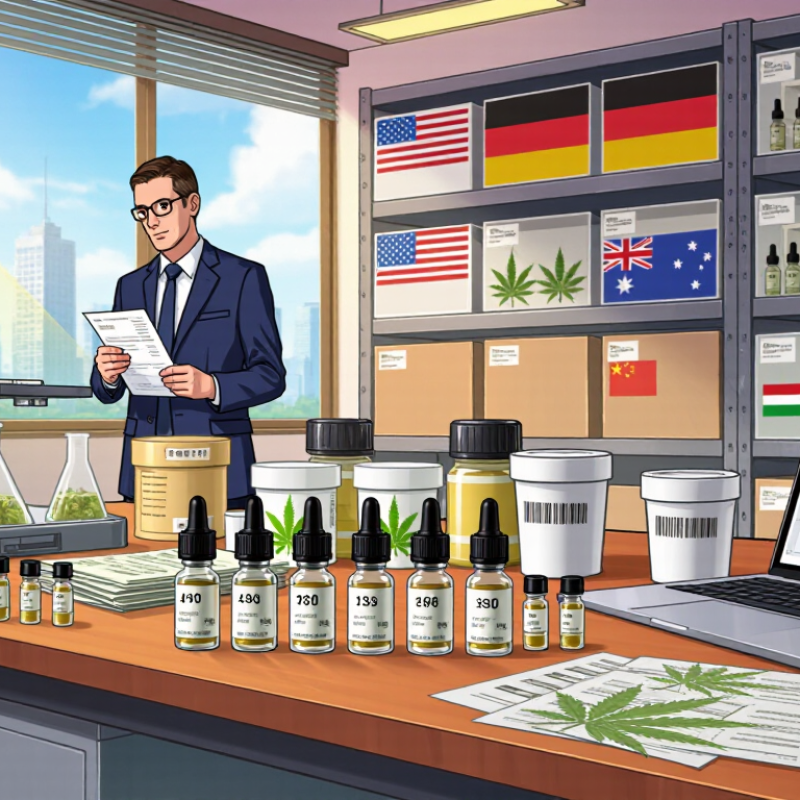
When sourcing CBD distillate globally, define potency targets before contacting suppliers. A clear specification should list CBD concentration, acceptable variation, and the maximum permitted THC level. Do not treat 0.2% or 0.3% as universal rules. Thresholds differ by market, product category, testing method, and whether authorities measure total THC or delta-9 THC.
Set the target in writing. For example, request a CBD range of 80–90% and a THC result below the destination market’s legal limit. Then confirm how the laboratory calculates results. A finished product may face different limits from a raw ingredient. The certificate of analysis should match the exact production lot, not a promotional sample. Check the report date, laboratory accreditation, detection limits, cannabinoid profile, and testing method.
Small details matter.
Ask suppliers for retained samples and sealed packaging information. Compare the sample’s color, viscosity, odor, and laboratory results after transport. Heat exposure can affect appearance and handling, even when potency remains acceptable. A useful sourcing file should include the specification, batch number, country of origin, transport conditions, and independent test results.
One uncomfortable issue is overconfidence. A supplier may state “compliant worldwide,” but no single certificate proves compliance everywhere. Regulations change, and testing interpretations are not always consistent. Recheck the destination market before each shipment. This step feels repetitive, yet skipping it can make a carefully sourced distillate unsuitable for import or sale.
Tip 1: Map each destination before purchasing. In the EU, the European Commission’s Novel Food Catalogue lists CBD extracts as novel foods. Commercial sale generally requires authorization, safety evidence, and national compliance checks. Rules may differ between member states.
Tip 2: Verify the U.S. threshold carefully. The 2018 Farm Bill defines hemp as cannabis containing no more than 0.3% delta-9 THC by dry weight. USDA production rules and state requirements still apply. A compliant certificate should show delta-9 THC, total THC, cannabinoids, pesticides, solvents, heavy metals, and microbiology. The 2023 National Academies review also noted inconsistent testing practices across hemp products. That warning deserves attention.
Tip 3: Treat local limits as separate specifications. Some markets restrict THC to trace levels, while others regulate CBD foods, cosmetics, or supplements differently. The European Food Safety Authority’s novel food assessment work has highlighted safety data gaps, including exposure and impurity concerns. Ask suppliers for batch-specific certificates, validated methods, sampling dates, and laboratory accreditation. Check whether results use dry-weight calculations or finished-product concentrations.
A practical sourcing file should include harvest origin, extraction records, transport documents, and storage conditions. Small details matter. Distillate can change during heat exposure. I would not rely on one laboratory report alone. Regulatory interpretation also changes, so obtain written advice from qualified counsel in the receiving market before shipment.
Sourcing compliant CBD distillate globally requires more than reviewing a polished specification sheet. Start by asking whether the supplier operates an ISO 9001 quality management system. This shows controlled procedures for purchasing, production, training, deviations, and corrective actions. However, certification alone is not proof of product quality. Check the certificate scope, issuing body, validity dates, and covered facility.
ISO/IEC 17025 competence is equally important for laboratory testing. Ask whether the laboratory’s accreditation covers cannabinoid analysis, contaminants, and relevant sample matrices. Request complete certificates of analysis, not cropped summaries. Results should identify batch numbers, test methods, detection limits, sampling dates, and authorized approval. A practical review compares the distillate drum label with the laboratory report, invoice, and shipping documents. Small mismatches can reveal weak controls.
Traceability should work in both directions. You should be able to trace a finished batch back to its raw material, processing date, equipment record, and responsible operator. You should also know which customers received that batch. Confirm sealed packaging, storage temperatures, retention samples, and documented transport conditions. Ask how the supplier handles complaints, recalls, and unexpected results. Their answer matters more than a perfect sales presentation.
A supplier may provide impressive documents while lacking daily discipline. I have found that simple records are sometimes more reliable than elaborate claims. Still, remote document reviews have limits. An independent audit or qualified local inspection can expose gaps that paperwork misses. Before importing, verify destination-country requirements with competent regulatory counsel and confirm every batch meets the applicable rules.
Sourcing compliant CBD distillate globally begins with a clear product specification. Define the permitted cannabinoid profile, intended use, and destination-market requirements before contacting suppliers. Regulations differ by country and sometimes by region. A compliant shipment in one market may fail in another.
Request a recent Certificate of Analysis for every production batch. The report should identify the sample, batch number, test date, laboratory, and analytical methods. Prefer an independent laboratory with ISO/IEC 17025 accreditation. Verify cannabinoids through suitable chromatographic testing, including CBD, THC, and minor cannabinoids where relevant. Do not rely on a single headline percentage. Details matter.
Pesticide and residual-solvent panels deserve equal attention. Check the laboratory’s reporting limits, not only “pass” statements. The COA should show detected levels, limits of quantification, and applicable standards. Ask the laboratory to test a sealed retain sample when risk is high. Compare the report with the supplier’s specification and shipping documents. I have found that mismatched batch codes often reveal weak controls, even when the numbers look impressive. That deserves scrutiny.
Keep the original COA, sampling records, and communication trail. A supplier’s confidence is useful, but independent evidence is stronger. If a report lacks methods, signatures, or clear sample identity, pause the purchase. Do not guess. Confirm the destination jurisdiction’s rules with qualified local counsel before importing any hemp-derived material.
| No. | Sourcing Tip | Required Evidence | Verification Criteria | Recommended Control | Risk Signal |
|---|---|---|---|---|---|
| 1 | Confirm the legal status in the destination market | A current regulatory assessment covering the product form, intended use, THC level, import route, and local labeling requirements. | Do not assume that hemp legality in the origin country permits import, sale, or use in the destination country. In the United States, federal hemp is generally defined by delta-9 THC not exceeding 0.3% by dry weight, while state requirements may differ. In the European Union and United Kingdom, CBD foods and supplements may require novel-food authorization or other regulatory review. | Obtain written review from a qualified local regulatory professional before shipment. | “Legal everywhere” claims or a COA used as the only proof of import eligibility. |
| 2 | Verify the COA is batch-specific | A certificate of analysis showing batch or lot number, sample date, test date, laboratory identity, method references, and authorized approval. | The COA lot number, product description, manufacturing date, and sample quantity should match the physical shipment and commercial documents. A generic or undated COA cannot establish conformity for the delivered lot. | Require a new COA for each production batch and retain a sealed reference sample. | Missing lot number, inconsistent dates, unexplained edits, or results reported only as “pass.” |
| 3 | Confirm cannabinoid identity and potency | A quantitative cannabinoid profile covering CBD, CBDA, delta-9 THC, THCA, and other relevant cannabinoids for the destination market. | The method should distinguish acidic and neutral cannabinoids where relevant and report units clearly, such as % w/w or mg/g. Check the total THC calculation and confirm that the result is compared with the applicable legal threshold. | Use an appropriately validated chromatographic method, normally HPLC or an equivalent method capable of analyzing acidic cannabinoids. | Potency outside specification, THC reported without a calculation basis, or no detection limit shown. |
| 4 | Screen for pesticides and agricultural contaminants | A multi-residue pesticide panel appropriate for the crop, extraction process, and destination-market limits. | The report should list individual analytes, units, reporting limits, and results. “Not detected” is meaningful only when the laboratory’s reporting limit is suitable for the applicable limit. | Test both incoming biomass and finished distillate when concentration during extraction is reasonably possible. | One broad “pesticide pass” statement without an analyte list or reporting limits. |
| 5 | Verify residual solvents and processing chemicals | A residual-solvent report covering every solvent used during extraction, winterization, distillation, cleaning, or reprocessing. | Results should be reported in ppm or another stated unit and evaluated against the applicable pharmacopeial or food-safety limit. Solvent-free processing does not remove the need to assess other possible processing contaminants. | Require process disclosure under confidentiality terms and test with a suitable gas-chromatography method. | Undisclosed extraction solvent or a report that tests only one solvent regardless of the process. |
| 6 | Add heavy metals, microbiology, and mycotoxin controls | Finished-product testing for lead, arsenic, cadmium, mercury, microbial organisms, and relevant mycotoxins. | Hemp can accumulate contaminants from soil, and concentration may occur during extraction. Compare results with the specification for the intended product category, route of administration, and destination market. | Set written acceptance limits before purchase and reject any lot that exceeds them, even if the supplier’s internal specification is less strict. | Testing only cannabinoids while omitting safety contaminants. |
| 7 | Use independent laboratory confirmation and supply-chain controls | Third-party laboratory results, laboratory accreditation or competency evidence, chain-of-custody records, GMP documentation, traceability records, and a change-control procedure. | The laboratory should be independent from the seller and competent for the methods used. Sampling should be representative, documented, and protected against substitution or tampering. | Perform pre-shipment testing for the first orders, periodic random re-testing, and testing after any change in source material, process, facility, or specification. | Supplier-selected results only, no chain of custody, or refusal to permit independent sampling. |
Sourcing compliant CBD distillate globally requires more than comparing prices. Tip 1: Verify the supplier’s legal authorization, facility records, and batch traceability before requesting samples. Tip 2: Confirm the product’s cannabinoid profile matches the destination country’s current rules. Regulations can differ between neighboring markets. A familiar label is not proof of compliance.
Tip 3: Agree on Incoterms in writing. They define transport costs, insurance, customs responsibilities, and when risk transfers. They do not make restricted goods lawful. Tip 4: Review the proposed HS code with an experienced customs broker before shipment. A wrong code can trigger delays, reassessment, or seizure. My practical mistake was treating a supplier’s code as final. It was not.
Tip 5: Request recent certificates of analysis from an independent laboratory. Check cannabinoids, pesticides, heavy metals, residual solvents, microbial limits, and batch identity. Tip 6: Ask for stability data covering six to twelve months, including storage temperature, light exposure, packaging, and test intervals. A single fresh COA is insufficient. Tip 7: Match the data to real transport conditions, such as a hot container or cold warehouse. Keep signed specifications, invoices, permits, and test reports together. Documentation often fails at handover, even when the material itself meets expectations. Use a small pilot shipment first.
Control import risk with Incoterms, HS codes, and 6–12-month stability data.
The chart highlights objective reference points for a global CBD distillate sourcing plan: Incoterms® 2020 contains 11 rules, the internationally harmonized HS structure uses six digits before national extensions, and a robust stability package should include at least six months of data, with twelve months providing stronger shelf-life support. HS classification, THC limits, import permissions, and documentation must still be confirmed for the origin, transit, and destination jurisdictions.